




























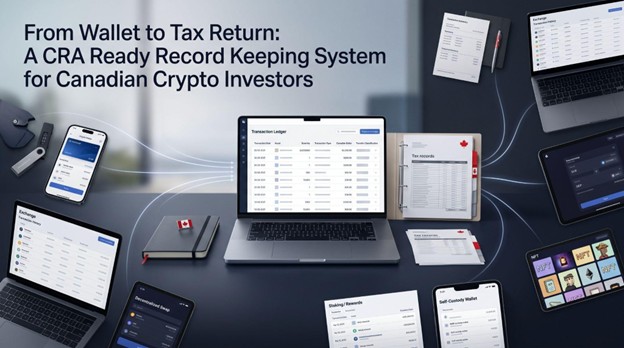
Crypto tax reporting gets complicated long before filing season. A few trades on one exchange may be manageable from a spreadsheet or year-end statement. But once activity is spread across centralized exchanges, self-custody wallets, staking platforms, NFT marketplaces and DeFi protocols, the record can quickly fragment. One wallet shows a withdrawal, another shows a deposit, a decentralized exchange records a token swap, and a platform summary may capture only part of the picture.
That is why crypto tax record keeping in Canada is less about downloading one report and more about building a defensible transaction history. The goal is not simply to calculate a number at the end of the year. It is to preserve a complete, readable trail that shows what happened, when it happened, what each asset was worth in Canadian dollars and whether a movement of assets was a taxable event or just a transfer between your own wallets.
This article provides general educational information, not personalized tax or legal advice.
Why Canadian Crypto Investors Need a Complete Transaction History
For Canadian crypto users, the basic challenge is that the CRA expects books and records that support each transaction, not just an end-of-year balance. That means keeping enough detail to explain acquisitions, dispositions, transfers, fees and wallet balances over time. The CRA also expects values to be tracked in Canadian dollars, which is where many records begin to break down. A platform may show a token amount and a U.S. dollar value, but your return still needs a supportable Canadian-dollar record.
A complete crypto transaction history matters because cryptocurrency taxes in Canada turn on what actually happened at the transaction level. Selling for cash is one kind of event. Swapping one token for another is another. Using crypto to buy something can also matter. Even when there is no sale to Canadian dollars, there may still be a reportable disposition.
The CRA also generally requires taxpayers to keep relevant books and records for at least six years from the end of the last taxation year to which they relate. That is a long time to rely on the hope that an exchange will still be operating, still serving Canadians and still preserving your full account history in exportable form.
This is where many investors run into trouble. A year-end tax summary from an exchange may capture activity on that exchange, but it often misses off-platform wallet transfers, on-chain swaps, NFT purchases, wrapped tokens, staking rewards or movement through decentralized protocols. For CRA cryptocurrency records, partial platform summaries are useful supporting documents, but they are not a substitute for a complete ledger.
Start by Mapping Every Account, Wallet and Platform
The first practical step is not tax software. It is inventory. Before you can classify transactions, reconstruct adjusted cost base for cryptocurrency or review a potential crypto disposition Canada issue, you need a map of every place your assets touched.
For many investors, that map is broader than expected. The obvious platforms are usually easy to remember. The forgotten ones are the problem: an exchange account opened during a bull market, an unused browser wallet, an old staking platform, a marketplace login tied to an email address you no longer monitor.
A useful starting inventory should include:
- Every centralized exchange account, including inactive or closed accounts
- Each hardware wallet and the wallet software used to access it
- Each self-custody wallet, including browser extension and mobile wallets
- Staking platforms and validator-related accounts
- Lending or yield platforms
- DeFi protocols used for swaps, liquidity pools or borrowing
- NFT marketplaces and minting platforms
- Mining accounts, if any
- Fiat on-ramps, off-ramps and payment apps used to buy or sell crypto
- Any account shared with a spouse, business or corporation, where ownership needs to be clearly identified
This list matters because reconstruction usually fails at the edges. If one platform is missing, the ledger may show an unexplained withdrawal. If an inactive wallet is forgotten, what looks like a taxable sale may actually have been an internal transfer. Good Canadian crypto tax compliance starts with a complete map, even before you begin calculating.
Separate Taxable Events from Transfers Between Your Own Wallets
One of the most important distinctions in crypto tax reporting is the difference between a disposition and a transfer between wallets you still own and control.
In general terms, common dispositions include selling crypto for Canadian dollars, exchanging one crypto-asset for another, using crypto to buy goods or services, and transferring ownership through a gift. Those events can trigger tax consequences because you have disposed of one property interest, even if no cash hits your bank account.
By contrast, moving assets between wallets you control ordinarily does not create a disposition if beneficial ownership does not change. That is a record-keeping point as much as a tax point. The transfer still needs to be documented so the outgoing transaction from one location can be matched to the incoming transaction at another.
A simple example shows why this matters.
If you move Bitcoin from a Canadian exchange to your own hardware wallet, that movement is usually a transfer, not a sale, assuming you remain the beneficial owner throughout. But if you use that Bitcoin to acquire Ether, the Bitcoin has been disposed of and the trade becomes part of your crypto swap tax Canada record.
In practice, internal transfers are often the most time-consuming part of reconstruction. Network fees, partial transfers, timing gaps and wallet labeling errors can make an internal movement look like a disposal unless you preserve addresses, transaction hashes and timestamps. For self custody wallet records, this matching exercise is essential.
Reconstruct Canadian Dollar Values and Adjusted Cost Base
Once the ledger is mapped, the next challenge is valuation. For Canadian purposes, a crypto transaction record is not complete unless the activity can be tied to a reasonable Canadian-dollar value at the time of the transaction.
That applies whether the event occurs on a centralized exchange, in a peer-to-peer transaction or on-chain through a DeFi protocol. The practical question is not whether the platform displayed a price, but whether you can support the crypto fair market value in Canadian dollars used in your records.
For most investors, that means choosing a consistent valuation method and sticking with it. If you use exchange spot data, benchmark pricing or another reliable source, apply the same approach consistently across similar transactions. Inconsistent sourcing is one of the easiest ways to create noise in a file that later needs to be reviewed.
Adjusted cost base for cryptocurrency also depends on disciplined tracking. When identical units of a crypto-asset are acquired at different times and prices, the running cost base must be updated to reflect subsequent acquisitions and dispositions. Fees matter too. Depending on the nature of the transaction, fees may affect the cost of acquiring an asset or the proceeds on disposition, which is why fee records should never be ignored as immaterial.
This is not an area for rough estimates. If your records show token quantities to eight decimal places but your Canadian-dollar values are inconsistent, the ledger will still be hard to defend. A CRA-ready file is one in which quantities, dates, values and fees all connect logically.

Account for Staking, DeFi, NFTs and Other Complex Activity
Basic buy-and-sell activity is only one part of modern crypto investing. Many portfolios now include staking rewards and crypto taxes questions, decentralized finance activity, NFT transaction records, lending arrangements, wrapped assets, airdrops or assets received through protocol events.
These activities are harder to organize because software labels can be misleading. A platform may classify an on-chain event as a deposit, reward, swap, bridge or contract interaction, but the label alone does not determine the reporting treatment. It only describes how the platform saw the movement.
That is why DeFi tax reporting Canada files usually need human review. A liquidity pool transaction, for example, may involve contributing one or more tokens, receiving a liquidity token, earning rewards and later unwinding the position through a separate sequence of events. A wallet export may not explain the commercial substance clearly enough on its own.
The same applies to wrapped tokens and bridges. Moving an asset across chains may appear simple at the user level, yet the underlying steps can produce multiple on-chain entries. NFT activity can be equally messy, especially where minting, listing, canceling, royalty receipts and marketplace fees all appear separately.
Staking deserves special attention because reward entries may be frequent, small and scattered across platforms. Even when the economics feel straightforward, the records may not be. Investors should review software-generated categorizations rather than accepting them automatically. The technology may summarize, but the taxpayer still needs a coherent file.
Determine Whether the Activity May Be Capital or Business Income
A complete record is also necessary because crypto gains in Canada are not always characterized the same way. Depending on the facts, activity may be treated as capital gains or as business income.
The CRA looks at this case by case. Relevant factors can include frequency of transactions, length of holding periods, knowledge of the market, time devoted to the activity, the use of financing and whether the overall conduct resembles a commercial venture. No single factor is determinative, and no one checklist settles the issue on its own.
That is an important point for active traders, professionals and business owners. High-volume activity does not automatically dictate one result, but it can increase scrutiny around business income versus capital gains questions. The stronger your records, the easier it is to explain the pattern of activity rather than relying on memory after the fact.
For investors around Bay Street, in Toronto’s Financial District or among the city’s broader technology sector, this issue often arises where personal investing overlaps with more sophisticated trading habits. The answer is not to assume a label. It is to maintain records that allow the facts to be evaluated properly.
Build a CRA Ready Crypto Tax File
A CRA-ready file is not just a folder of CSV exports. It is an organized record that allows someone else, including an advisor or reviewer, to follow the story of the portfolio from opening balances to closing balances.
At a practical level, the file should capture:
- Transaction dates and timestamps
- The type of asset involved in each entry
- Quantities sent, received, bought, sold or earned
- Wallet addresses and account identifiers
- Transaction hashes for on-chain activity
- The Canadian-dollar value used for each relevant entry
- The valuation source or methodology used
- Transaction and network fees
- Centralized exchange records and full account ledger exports
- Transfer ledgers that match withdrawals to deposits between your own wallets
- Receipts, invoices and purchase confirmations where crypto was used to acquire something
- Beginning and ending balances by asset for each year
- Notes explaining unusual items, such as missing records, token migrations, forks, bridge activity or platform shutdowns
That final item matters more than many people realize. Good CRA crypto audit documentation often includes short explanatory notes. If an exchange ceased operating, a wallet was compromised, or a transaction had to be reconstructed from blockchain records, state that clearly in the working papers. Silence creates ambiguity. A concise note creates context.
It also helps to preserve records in more than one place. Export files should be backed up, organized by year and platform, and saved in a format that can still be opened later. This is especially important for centralized exchange records, because access terms, product offerings and data retention practices can change.
When a Portfolio May Require Professional Review
Some portfolios move beyond do-it-yourself cleanup. That does not mean the taxpayer has done anything wrong. It usually means the record is complex enough that a second review is sensible.
Professional review may be appropriate when records are incomplete, activity spans several years, classification between capital and business treatment is unclear, or the portfolio includes extensive DeFi, staking, mining, NFT or foreign platform activity. Investors with extensive multiwallet activity or unresolved reporting questions may choose to consult a Crypto Tax Accountant Toronto before filing or correcting a previous return.
That can be especially relevant for Toronto crypto investors whose activity intersects with a business, a professional corporation or a family investment structure in North York’s business community or elsewhere in the GTA. The point is not promotion. It is recognition that some files require interpretation as well as bookkeeping.
A Year Round Record Keeping Routine
The easiest crypto tax file to manage is the one that is maintained during the year rather than rebuilt under deadline pressure. A simple monthly or quarterly routine can prevent small record gaps from becoming major reconstruction projects later.
Start by exporting platform activity on a regular schedule. Do not assume a year-end download will always be available. Then reconcile wallet transfers while the transactions are still familiar. A transfer that is obvious today can be surprisingly hard to identify eighteen months later.
Next, record Canadian-dollar values using your chosen methodology and capture screenshots or pricing references when an event is unusual or not well documented by the platform. Back up CSV files, wallet reports and supporting notes in an organized folder structure. If something odd occurs, such as a token migration, bridge failure, contract exploit or platform closure, add a short explanation while the facts are fresh.
A disciplined routine does not eliminate complexity, but it contains it. That is the real value of a CRA-ready system. Accurate records make reporting more defensible, reduce the risk of inconsistent treatment and spare you from reconstructing years of crypto transaction history after the details have gone cold.
FAQS
Is transferring cryptocurrency between my own wallets taxable in Canada?
Generally, moving cryptocurrency between wallets you own and control is not, by itself, a taxable event in Canada if beneficial ownership does not change. The key is documentation. You should keep records that connect the withdrawal from one wallet or platform to the deposit in the other, including dates, amounts, wallet addresses, transaction hashes and any related network fees. Without that support, an internal transfer can be harder to distinguish from a disposition.
Is exchanging Bitcoin for another cryptocurrency a taxable event?
In general, yes. Exchanging Bitcoin for another cryptocurrency is commonly treated as a disposition of the Bitcoin because you gave up one crypto-asset to acquire another. Even if no Canadian dollars were received, the transaction still needs to be valued in Canadian dollars at the time of the swap for record-keeping and reporting purposes. That is why crypto-to-crypto trades should be tracked carefully in the same way as sales for cash.
How long should Canadian crypto investors retain transaction records?
The CRA generally requires taxpayers to keep the necessary books and records for at least six years from the end of the last taxation year to which they relate. For crypto investors, that can include exchange exports, wallet histories, transaction hashes, Canadian-dollar valuations, receipts and notes explaining unusual transactions. Because some platforms may close, restrict Canadian users or limit historical access, it is wise to export and back up records regularly rather than relying on future access.
What should I do if an exchange has closed or my transaction history is incomplete?
Start by gathering whatever records still exist, including old CSV exports, email confirmations, wallet histories, bank records and blockchain transaction data. Then rebuild the ledger as systematically as possible, matching deposits, withdrawals and swaps across platforms and wallets. Keep notes showing where records came from and where assumptions were necessary. If several years are affected or key classification issues remain unresolved, a professional review may be appropriate before filing or amending returns.